
Navigate the latest ISO 14001 updates with comprehensive insights into its pivotal Annex A for robust EMS implementation.
Key Insights for a Seamless ISO 14001:2026 Transition
The ISO 14001:2026 standard represents the latest evolution in environmental management systems (EMS), offering a sharpened focus on environmental performance and integration with broader business objectives. While the core requirements of Clauses 4-10 remain the backbone of the standard, the informative Annex A has undergone substantial revisions and expansions. This Annex is not mandatory, but its role is absolutely critical: it serves as the definitive interpretive guide, providing invaluable explanations, practical examples, and clarifications to ensure effective implementation and successful external audits.
The enhancements within Annex A are designed to reduce ambiguity, improve readability, and offer practical support for organizations navigating the complexities of modern environmental stewardship. By providing a detailed breakdown of its guidance, organizations can better understand the intent behind the standard’s requirements and apply them more consistently, ultimately leading to improved environmental performance and more sustainable outcomes.
Annex A is foundational for any organization seeking to implement or transition to ISO 14001:2026. It acts as an interpretive companion, illuminating the nuances of the standard’s clauses. While its guidance is informative rather than prescriptive, it is indispensable for comprehending the spirit and practical application of each requirement.
The 2026 iteration sees Annex A significantly expanded, aligning more closely with the Harmonized Structure (formerly Annex SL) shared by other ISO management system standards.
This strategic alignment ensures greater consistency in terminology and structure across various management systems, simplifying integration for organizations pursuing multiple certifications (e.g., ISO 9001 for quality and ISO 45001 for occupational health and safety).
This harmonized approach promotes a more holistic and integrated management system that considers all aspects of an organization’s operations.
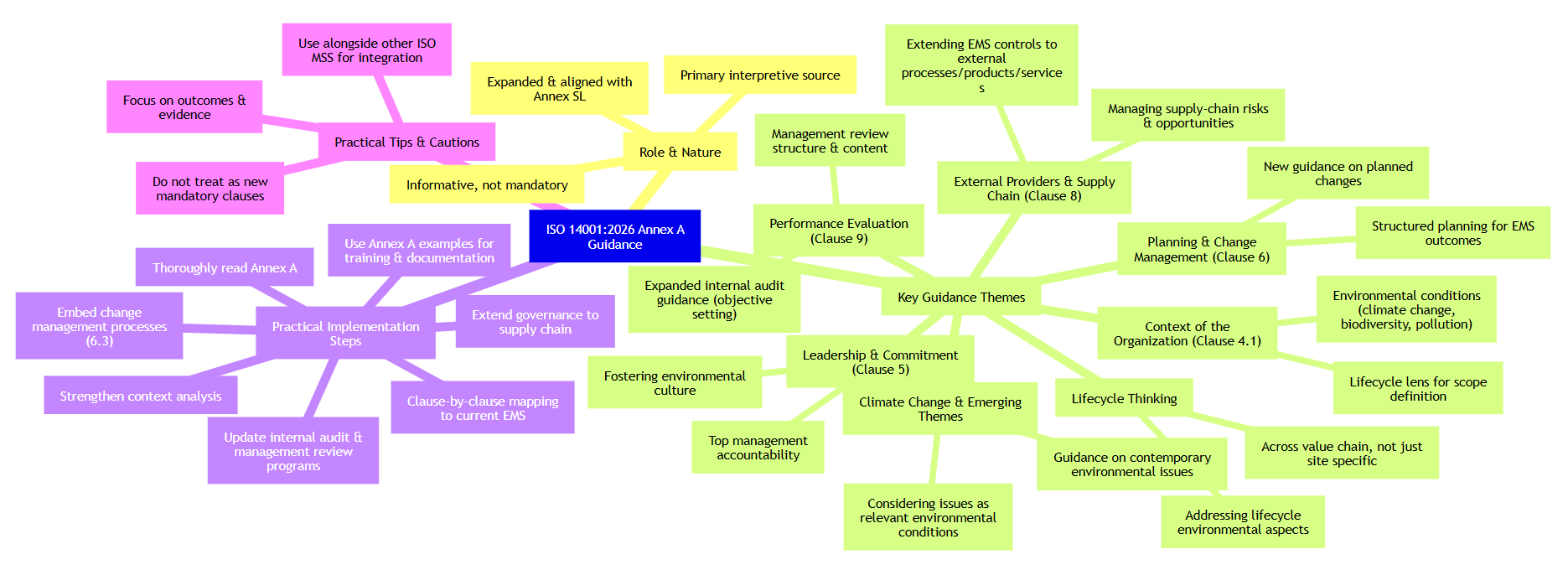
Mindmap illustrating the comprehensive guidance provided by ISO 14001:2026 Annex A, highlighting its key themes and implementation considerations.
Core Themes of Annex A Guidance and Their Application
The revised Annex A delves into several critical areas, offering enhanced guidance that directly impacts how organizations approach environmental management.
Context of the Organization (Clause 4.1)
Annex A provides enriched guidance on establishing the context of the organization, particularly concerning external and internal issues that affect its ability to achieve intended EMS outcomes.
It specifically calls out the need to consider evolving environmental conditions, such as climate change, biodiversity loss, pollution, and the availability of natural resources. This expanded perspective encourages organizations to look beyond immediate operational impacts and adopt a more holistic, forward-looking approach to environmental risk and opportunity assessment.
Leadership and Commitment (Clause 5)
The standard places a renewed emphasis on leadership’s active role in fostering an effective environmental culture.
Annex A offers clearer explanations and practical examples for top management, detailing their responsibilities in demonstrating commitment, accountability, and integrating environmental management into business processes.
This includes defining roles, assigning responsibilities, and ensuring that environmental objectives are aligned with strategic business goals. The guidance helps leaders understand how their involvement directly influences EMS performance and outcomes.
Planning and Change Management (Clause 6)
A significant addition to the guidance is a dedicated section on change management. Annex A provides detailed instructions on how organizations should plan for and control changes that could impact their environmental performance. This includes changes to products, services, processes, organizational structure, or regulatory requirements.
The guidance stresses the importance of systematically identifying potential environmental aspects and impacts associated with these changes, and developing appropriate controls to maintain or improve environmental performance.
Lifecycle Thinking and Perspective
While lifecycle thinking was present in the 2015 version, Annex A in the 2026 standard offers much clearer explanations and concrete examples for its application.
It clarifies that lifecycle perspective extends beyond an organization’s direct control, encompassing raw material extraction, design, production, transport, use, end-of-life treatment, and final disposal. This encourages organizations to consider environmental impacts across their entire value chain, fostering more sustainable product and service development.
Environmental Responsibility in the Supply Chain (Clause 8)
The revised Annex A explicitly addresses the management of environmental responsibilities within the supply chain. This means organizations are encouraged to extend their EMS controls to externally provided processes, products, and services.
The guidance provides methods for assessing and influencing the environmental performance of suppliers and contractors, ensuring that the organization’s environmental commitments are upheld throughout its extended operations.
Performance Evaluation and Improvement (Clauses 9 & 10)
Annex A refines the guidance for internal audits and management reviews. For internal audits, it clarifies the importance of defining clear objectives and scopes that align with the organization’s environmental aspects and compliance obligations.
For management reviews, it offers enhanced guidance on structuring and content, ensuring that these reviews effectively assess the EMS’s suitability, adequacy, and effectiveness, and drive continual improvement. The focus is on outcomes and evidence-based decision-making.
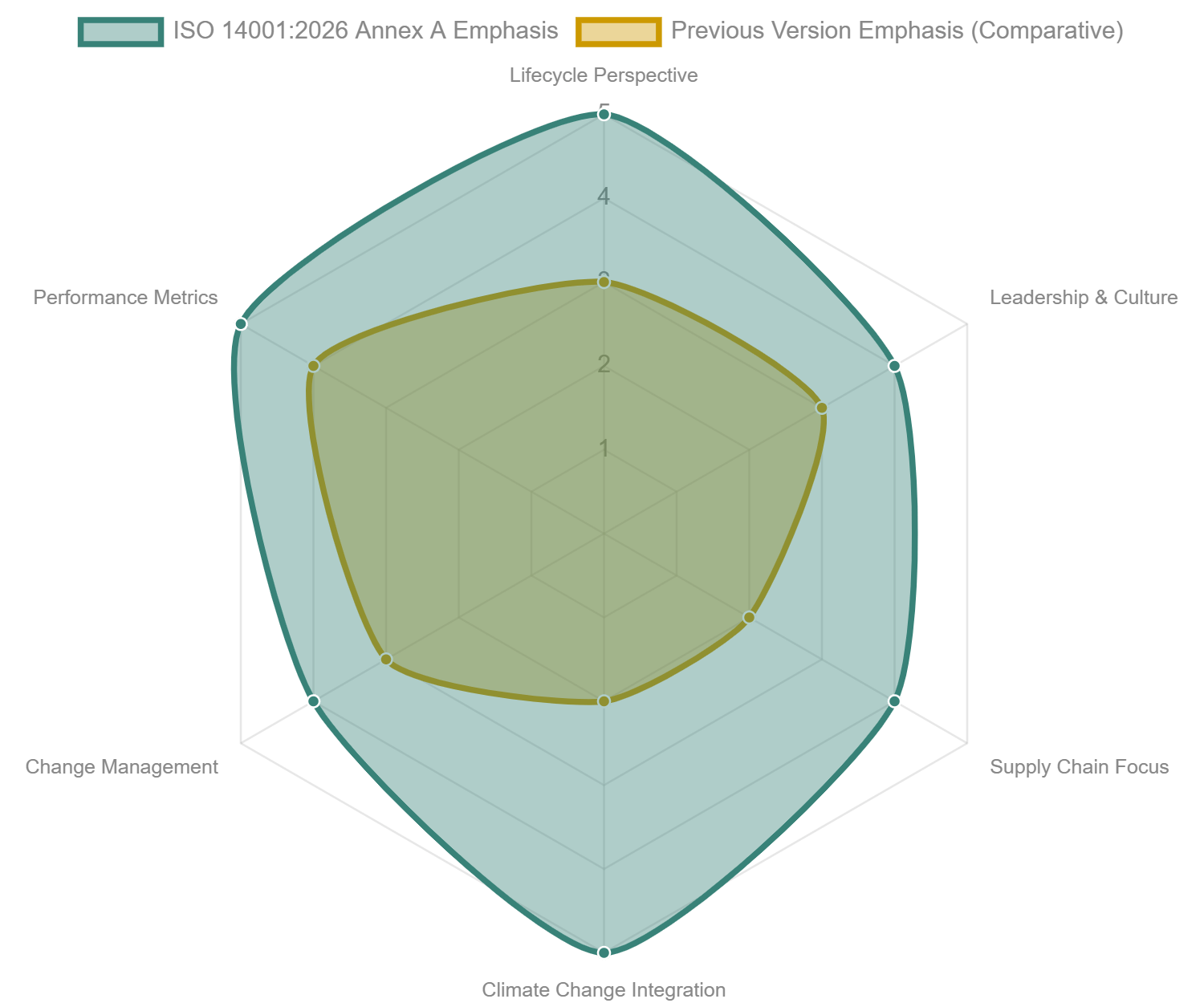
Radar chart comparing the emphasis of ISO 14001:2026 Annex A guidance against previous versions across key environmental management aspects. Higher scores indicate a stronger focus and more detailed guidance in the 2026 iteration.
To leverage the full benefit of Annex A, organizations should integrate its guidance into their EMS implementation strategy through several practical steps.
A fundamental step is to conduct a detailed, clause-by-clause review of Annex A against the organization’s existing EMS.
This involves identifying areas where current practices can be strengthened or new processes need to be established to meet the enhanced interpretations provided in the Annex. This self-assessment is crucial for understanding the transition requirements and preparing for certification.
Strengthen your context analysis by actively incorporating inputs related to climate change, biodiversity, and resource scarcity.
Document how these broader environmental considerations influence your organization’s scope, environmental aspects, and objectives. This proactive approach helps in setting relevant and impactful environmental goals.
Establish a formal workflow for managing changes that could affect the EMS. This includes assessing potential environmental impacts before implementing changes, documenting decisions, and ensuring that controls are in place to mitigate any adverse effects. This structured approach ensures that the EMS remains robust and effective even in dynamic operational environments.
Develop mechanisms to ensure that externally provided processes, products, and services align with your environmental commitments.
This could involve supplier assessments, contractual agreements, and monitoring key environmental performance indicators from your supply chain partners. The goal is to manage environmental risks and opportunities across the entire value chain.
Revise internal audit programs to reflect the updated guidance on audit objectives and scope. Similarly, update management review procedures to ensure that the content and structure of these reviews align with Annex A’s emphasis on outcomes and evidence.
This ensures that both internal audits and management reviews are more effective in driving continual improvement.
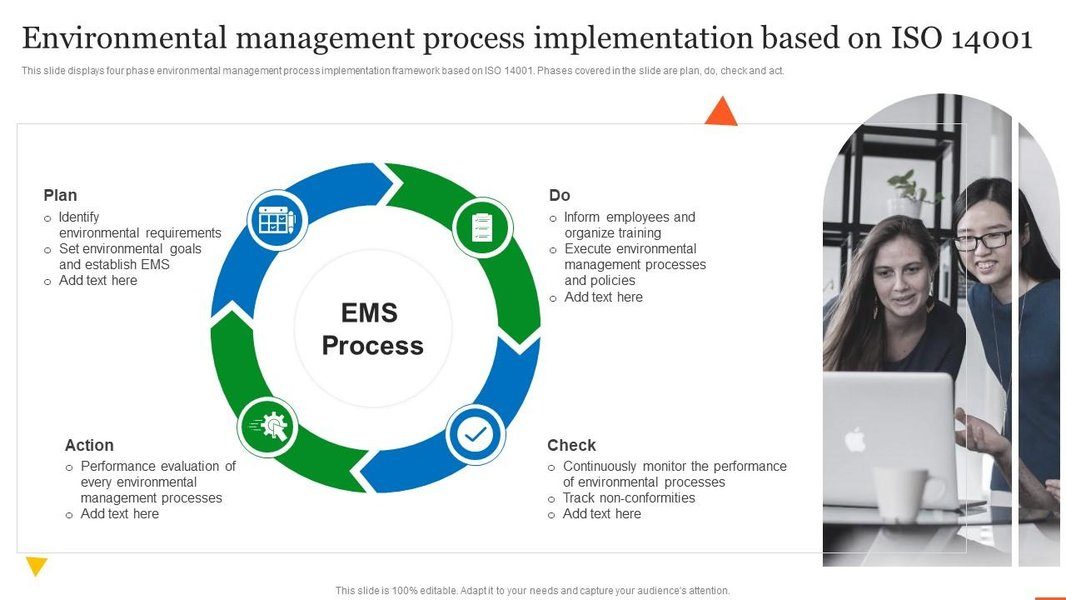
An illustrative process flow for environmental management system implementation based on ISO 14001.
The ISO 14001:2026 standard, with its refined Annex A, brings a more nuanced and rigorous approach to environmental management. The following table provides a comparative overview of how key aspects of an EMS are treated under the 2026 guidance versus previous iterations.
|
EMS Aspect |
ISO 14001:2026 (with Annex A Guidance) |
Previous ISO 14001 Versions (General Approach) |
|
Context of the Organization |
Expanded focus on global environmental conditions (climate change, biodiversity, resource availability) and stakeholder expectations; strong emphasis on lifecycle perspective in defining scope. |
Primarily focused on direct operational environmental aspects and legal compliance, with less explicit emphasis on global environmental issues. |
|
Leadership Engagement |
Detailed guidance on top management accountability, fostering environmental culture, and integration of EMS into business strategy for performance outcomes. |
Emphasis on management commitment and policy setting, but less explicit guidance on active integration into broader business processes. |
|
Lifecycle Perspective |
Clearer explanations and concrete examples for application across the entire value chain (raw materials to end-of-life); strong encouragement for holistic assessment. |
Concept introduced, but practical application guidance was less detailed, often leading to a focus primarily on direct operational control. |
|
Supply Chain Management |
Explicit guidance to extend EMS controls to externally provided processes, products, and services, including supplier environmental performance and risk management. |
General requirement to consider environmental aspects of externally provided goods and services, but less prescriptive on systematic control mechanisms. |
|
Change Management |
New dedicated guidance for planning and controlling changes that may impact environmental performance, ensuring EMS integrity through transitions. |
Changes managed implicitly through general planning and operational control clauses, without a specific, detailed guidance section. |
|
Performance Evaluation (Audits/Reviews) |
Refined guidance for internal audit objectives and management review structure/content, emphasizing evidence-based outcomes and continual improvement. |
General requirements for internal audits and management reviews, with less detailed guidance on focusing on performance outcomes. |
|
Emerging Environmental Themes |
Specific mention and integration of climate change mitigation/adaptation, biodiversity protection, and sustainable resource use as relevant environmental conditions. |
These themes were often addressed under general environmental aspects but lacked specific, prominent guidance for integration into the EMS. |
The revisions in ISO 14001:2026, particularly within Annex A, are designed to make the standard more robust, practical, and responsive to current global environmental challenges. By understanding and actively utilizing this guidance, organizations can achieve significant improvements in their environmental management systems.
Annex A’s emphasis on performance evaluation encourages organizations to adopt a more data-driven approach. By setting clear objectives for internal audits, tracking key performance indicators (KPIs), and structuring management reviews to focus on tangible outcomes, organizations can make informed decisions that lead to measurable environmental improvements.
This includes utilizing digital tools for monitoring and data analysis to identify trends and areas for optimization.
The harmonization with Annex SL and the explicit guidance on leadership involvement promote the integration of environmental management into overall business strategy.
By linking environmental performance to strategic goals, organizations can demonstrate how effective EMS contributes to business resilience, cost reduction (e.g., through waste reduction), and enhanced reputation. This transforms EMS from a compliance burden into a strategic asset.
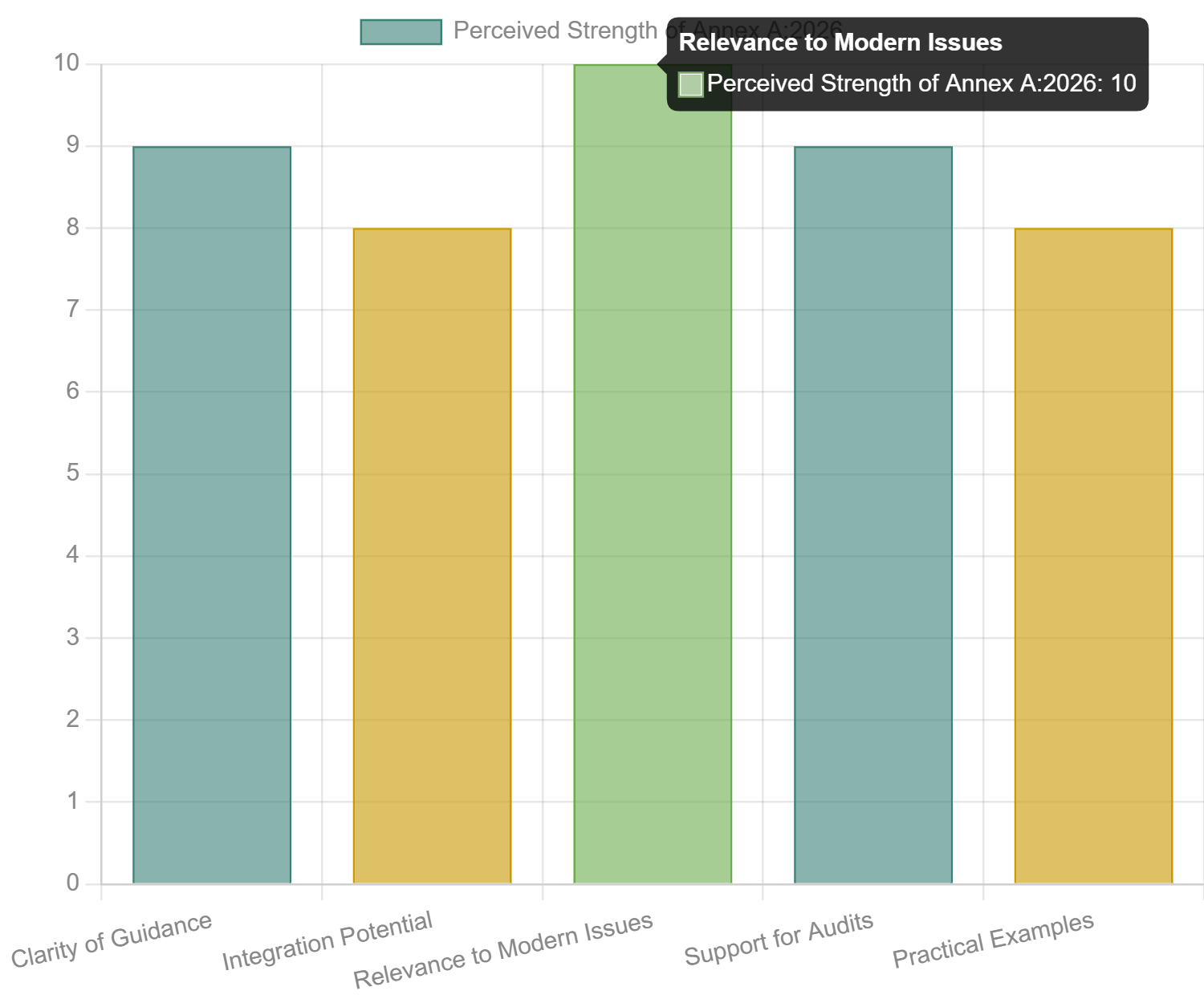
Organizations transitioning from ISO 14001:2015 to the 2026 version need to approach the process systematically, with Annex A as a critical guide.
A typical three-year transition period allows organizations ample time to update their EMS. During this period, organizations should utilize all available resources, including guidance from certification bodies and industry experts, to conduct thorough gap analyses and implement necessary changes. Annex A’s practical examples and explanatory notes are particularly valuable for training staff and preparing documentation.
Certification bodies universally recommend starting with a self-assessment against the new standard, paying close attention to the clarifications in Annex A. This proactive approach ensures that the EMS is aligned with the latest requirements and interpretations, facilitating a smoother certification process. Regular communication with your chosen certification body can also provide tailored insights and support.
Annex A serves as a crucial informative guide, providing detailed explanations, examples, and interpretations to help organizations effectively understand and implement the mandatory requirements outlined in Clauses 4-10 of the ISO 14001:2026 standard. It is not mandatory itself but is indispensable for correct application.
The updated Annex A explicitly guides organizations to consider climate change, biodiversity, pollution, and resource availability as relevant environmental conditions within their organizational context. This encourages integrating climate-related risks and opportunities into their EMS planning and objectives.
Yes, the revised Annex A is significantly aligned with the Harmonized Structure (Annex SL), which is common across other ISO management system standards like ISO 9001 and ISO 45001. This alignment simplifies the integration of multiple management systems within an organization.
The lifecycle perspective, as clarified in Annex A, requires organizations to consider the environmental impacts of their products and services from raw material acquisition through design, production, use, and end-of-life treatment. This encourages a holistic view of environmental responsibility across the entire value chain.
Annex A provides enhanced guidance on extending environmental management controls to externally provided processes, products, and services. This means organizations should manage the environmental responsibilities within their supply chain, including assessing and influencing the environmental performance of their suppliers and contractors.
Typically, a three-year transition period is provided for organizations to migrate from an older version of the standard (e.g., ISO 14001:2015) to the new ISO 14001:2026. This period allows sufficient time for gap analysis, system updates, and preparing for certification to the new version.
Conclusion
ISO 14001:2026, with its significantly enhanced Annex A, marks a pivotal advancement in environmental management standards. The expanded guidance, particularly in areas like lifecycle perspective, supply chain responsibility, leadership, and the integration of contemporary environmental issues, equips organizations with clearer directives for achieving robust environmental performance.
By diligently following the interpretive support offered in Annex A, organizations can not only ensure compliance but also strategically embed environmental stewardship into their core business practices, fostering greater sustainability and resilience in a rapidly changing world. The emphasis on outcomes, data-driven decisions, and a holistic view of environmental impacts positions organizations to meet current and future environmental challenges effectively.

Unfortunately You cannot copy contents for intellectual properties reasons :(
